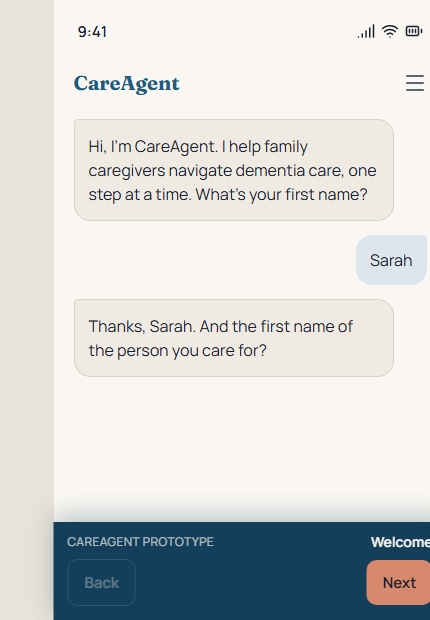
The live prototype. One question at a time, grounded in a real knowledge base.
01The problem
When a parent is diagnosed with dementia, the family is handed a mountain of legal and administrative work at the worst possible moment: power of attorney, benefit enrollment, care planning. It can take many months to get through, and mistakes are costly.
The thesis: a focused AI co-pilot can compress that first stretch from months into weeks by walking a caregiver through one concrete path at a time. This is personal. My mother-in-law has cared for her husband through Alzheimer's for over ten years.
02Before the code: the product work
This is the project where I did the full product-management workup before writing a line of the app. Whether an AI product is worth building is decided here, in the market, the competition, the customer, and the regulation, not in the model. It came together as a 20-slide investor deck. A few pages from it:
Market and customer
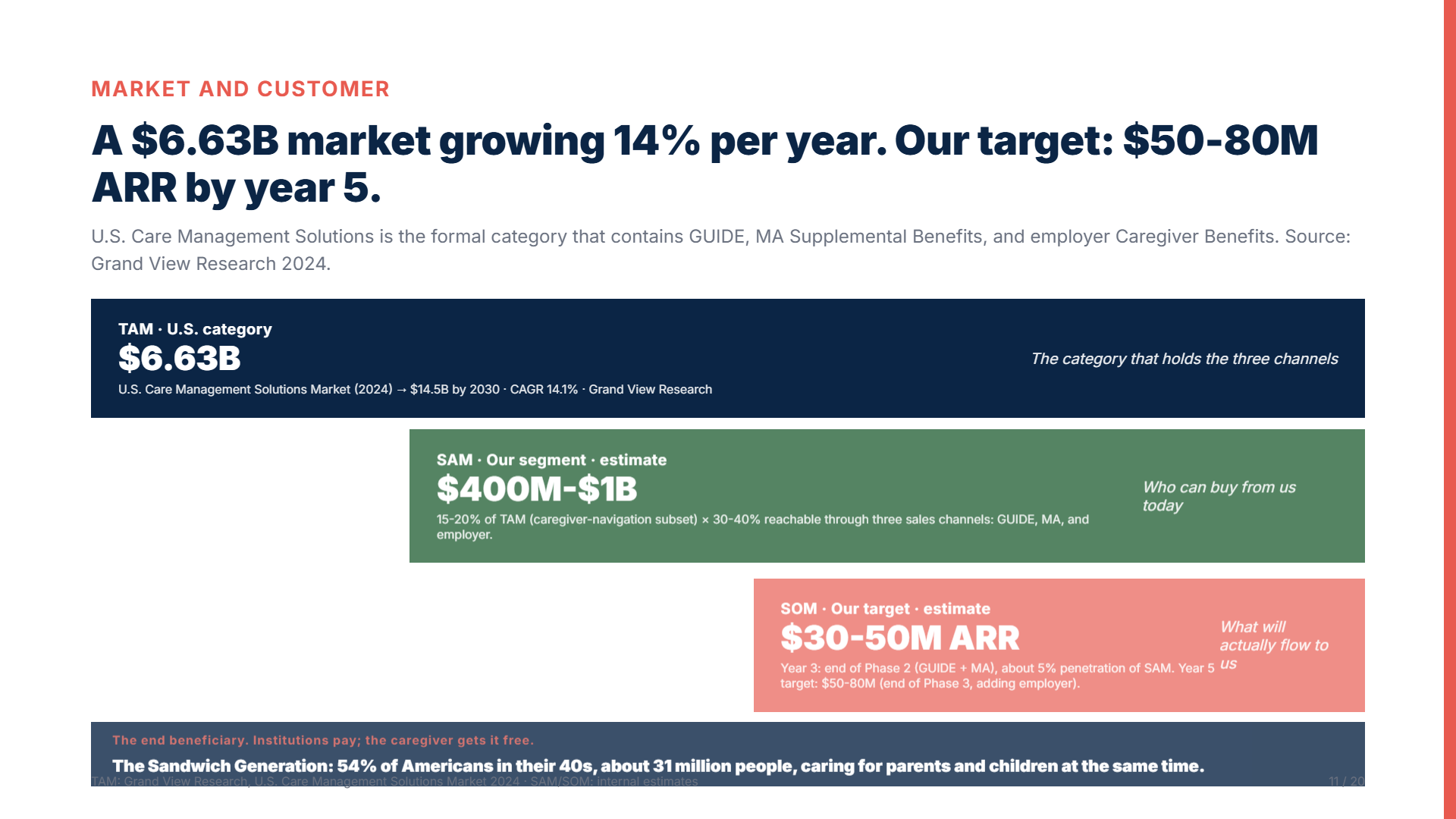
I sized it from the category down. The U.S. care-management-solutions market is about $6.63B (2024), growing to roughly $14.5B by 2030. I narrowed a reachable segment (SAM, $400M to $1B) and a realistic target (SOM, $30 to 50M ARR by year 3). Behind the money: 63 million unpaid US family caregivers, about $1.01 trillion in annual economic value, and roughly 12 to 13 million caring for someone with dementia. I wrote two concrete personas, the sandwiched adult daughter (50s, employed, time-poor) and the aging co-resident spouse (retired, fixed income, high care intensity).
Competitive landscape
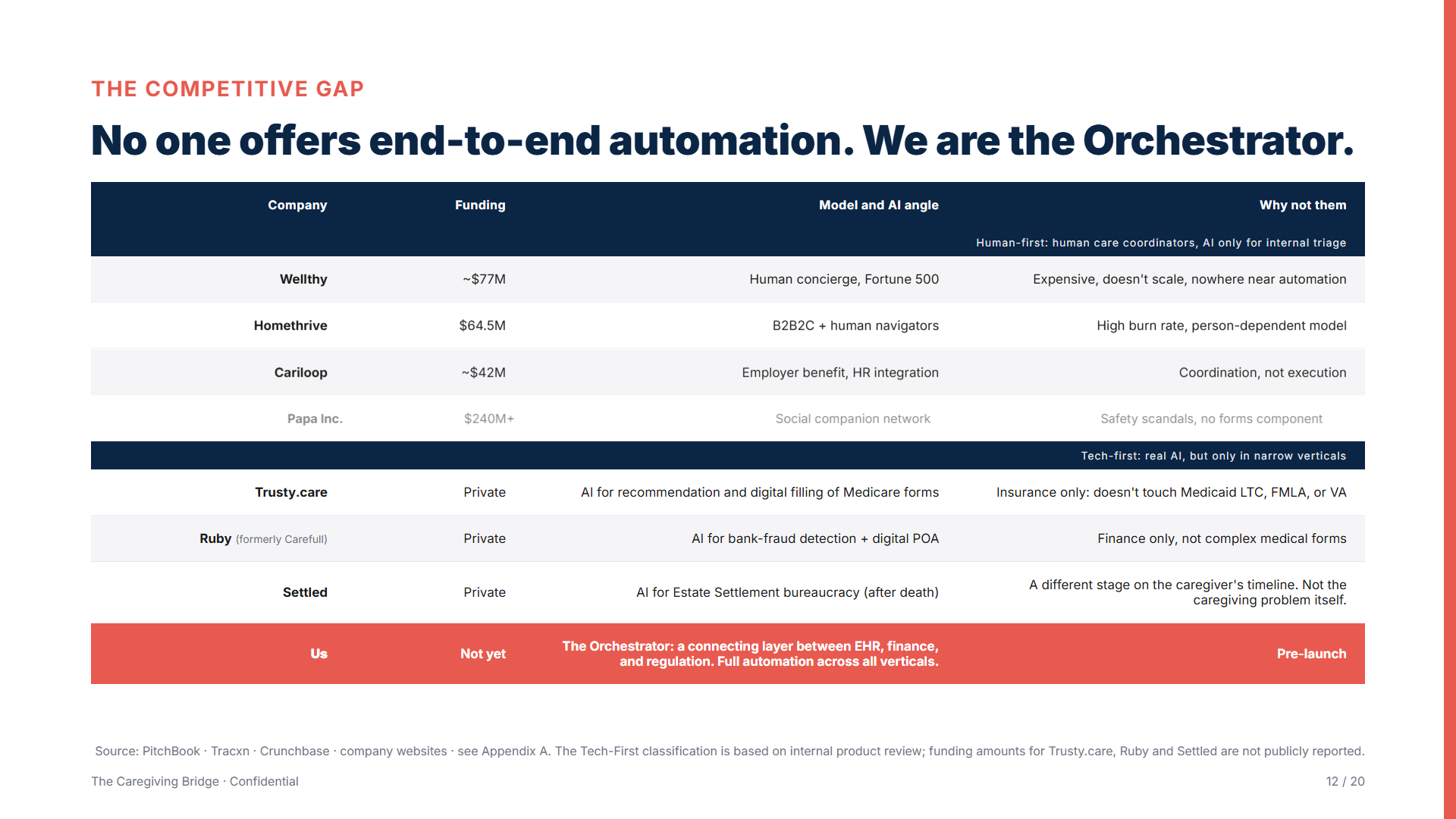
I mapped the funded field. The human-first incumbents (Wellthy, Homethrive, Cariloop, Papa) sell concierge navigation that does not scale, and the tech-first players each solve one narrow slice (insurance, finance, estate). The gap: nobody completes the bureaucracy end to end. That gap became the positioning, an orchestration layer that files the forms rather than another human coach.
Timing and regulation
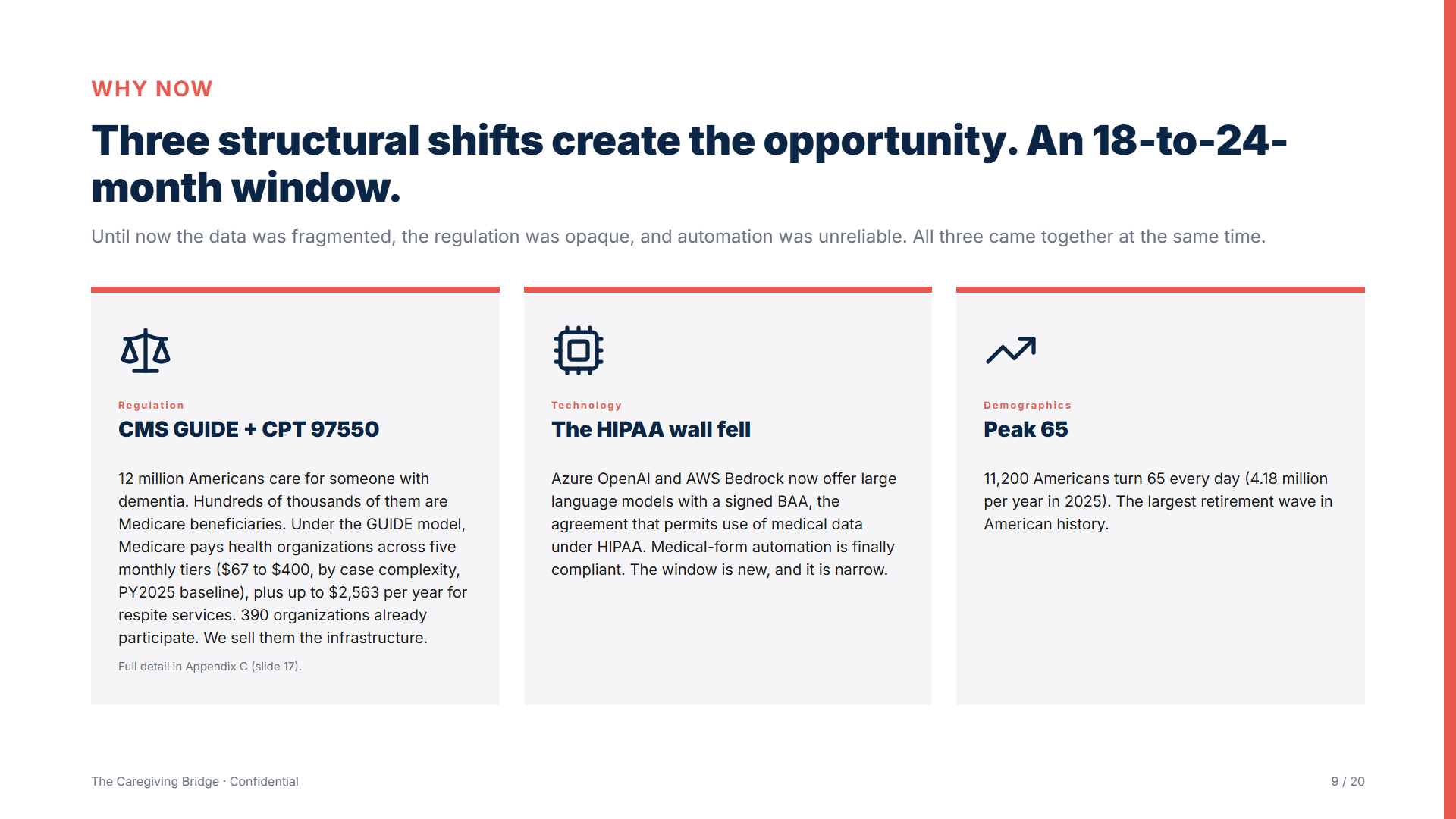
I checked why this is buildable now and was not two years ago. Three shifts line up: CMS's new GUIDE dementia-care model plus 2025 caregiver-training reimbursement codes, HIPAA-eligible LLMs via signed BAAs, and Peak 65 demographics. I also mapped the regulatory posture to keep the product out of FDA device territory: an administrative-support position for the bureaucracy arm and General Wellness for the support arm, with the caregiver retaining every decision.
Go-to-market and wedge
From there, a three-phase go-to-market: GUIDE organizations first as an evidence channel, self-insured employers as the early revenue channel, and Medicare Advantage later once the evidence exists. Then I narrowed the whole thing to one testable entry point, a durable-power-of-attorney and GUIDE-enrollment walkthrough, chosen after scoring several candidate wedges on demand, regulatory risk, and fit.
03Then the build
With the strategy settled, I directed the build of a working prototype to prove the hard part was tractable: a retrieval-grounded assistant (Next.js, Anthropic SDK, Supabase pgvector) that answers from a vetted knowledge base, not the model's memory. It walks the caregiver through one workflow at a time and is measured by a RAGAS eval harness against defined acceptance criteria, so answer quality is a number, not a vibe. Strict no-medical-advice posture, deferring to professionals at set boundaries.
Why this matters for a PM role
This is the full product-management arc in one project: market sizing, competitive intelligence, personas, go-to-market, and regulatory strategy, then a working prototype to prove it. Not a spec handed off to someone else, the whole thing, done end to end by one person.
04Status
Live prototype; the venture is on hold pending a US domain partner. I present it here as product-strategy work and a demonstration of how I take an AI idea from market to prototype, not as a shipped commercial product.