01The problem
AI coding agents are powerful but forgetful. Every session starts from zero: the same mistakes, the same missing context, the same hand-holding. Prompt libraries help, but they are static. They do not learn.
I wanted an agent that gets better the more I use it, without me rewriting its instructions by hand every time.
02What I built
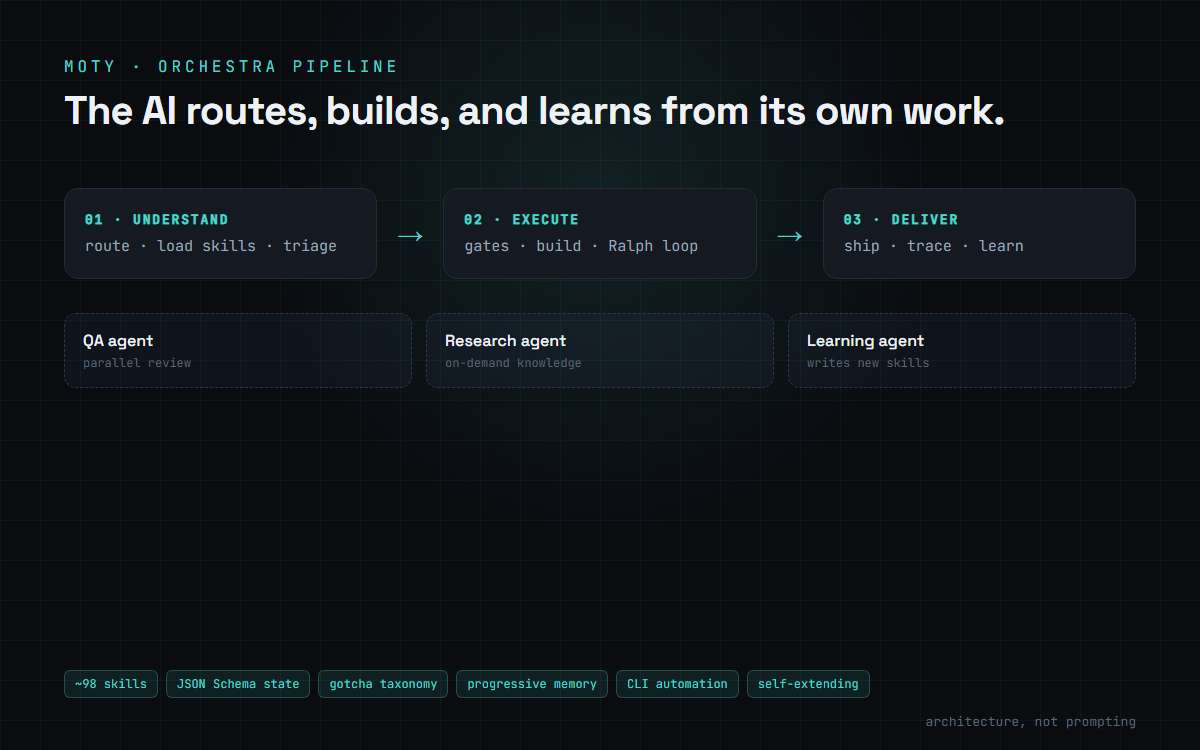
MOTY is a system layered on top of Claude Code. Instead of one giant prompt, it is a structured set of parts that compose:
- ~98 skills, each a self-contained capability with clear boundaries, loaded on demand to keep context small.
- A 3-phase orchestration pipeline (Understand, Execute, Deliver) that routes a task to the right skills, runs quality and research agents in parallel, and learns from the result.
- A skill-builder that lets the system create and register new skills when it hits a gap. The AI extends itself.
- A DNA layer: a small always-loaded character and rule set that keeps behavior consistent across every run.
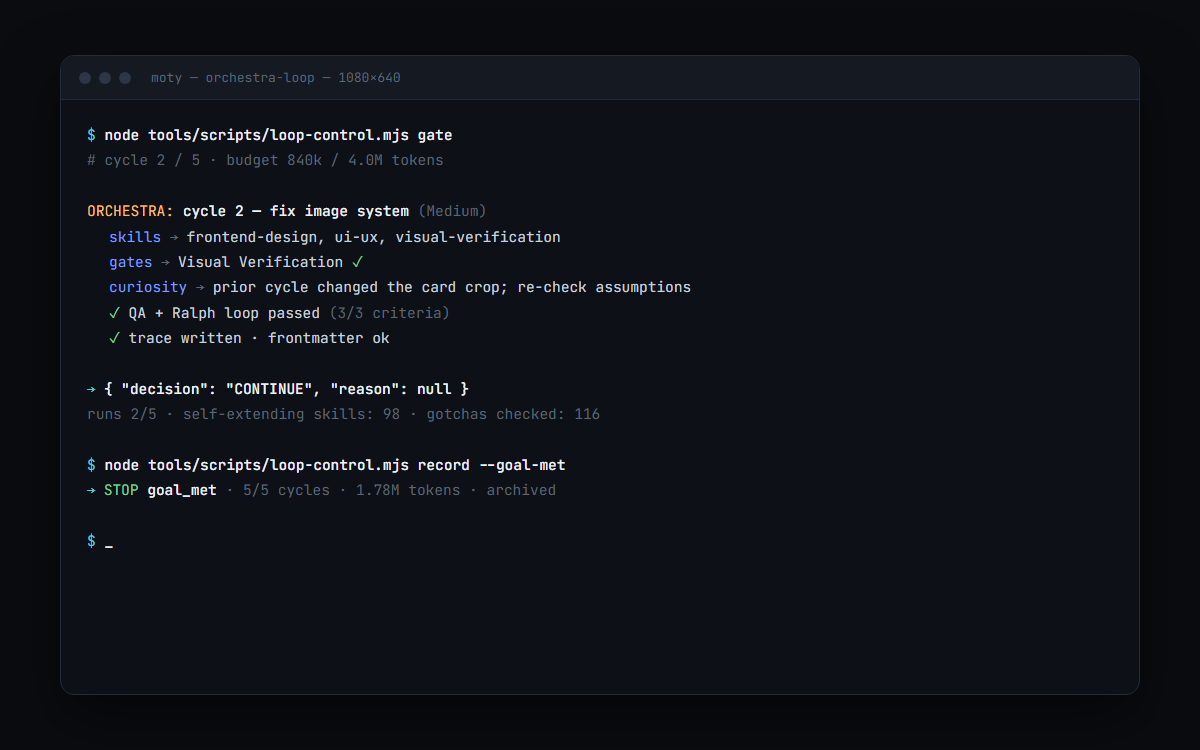
- A schema-validated state layer (JSON) that drives closed-loop automation from the command line.
03How it works
The interesting design choice was to treat cognition as architecture, not prompting. Rather than asking the model to "be careful," MOTY encodes carefulness into structure: mandatory gates, verification loops, a memory system with progressive disclosure, and a taxonomy of past mistakes (gotchas) the system checks itself against.
State lives in versioned JSON with a schema, so an automated loop can read where it is, decide the next step, and stop deterministically when a goal is met or a budget cap is hit. A companion desktop app (Tauri + React) renders the whole system as a live dashboard.
Why this matters for an AI PM role
MOTY is a data-modelling and automation problem end to end: schema design for the state layer, ruleset definition for the pipeline, API-shaped contracts between agents, and CLI automation with Claude Code at the center. It is a whole AI system taken from idea to daily use by one person.
04My role
Sole architect. I designed the skill taxonomy, the orchestration model, the memory and gotcha systems, and the state schema, and built the tooling with Claude Code. It is also my daily driver: this very portfolio was built by MOTY.